Send a Whatsapp Message
 Free shipping on orders above £49
The stethoscope for paramedic and pre-hospital use is a completely different problem from choosing one for a hospital ward. In addition, it is an environment that exposes every limitation of a conventional stethoscope — and most of them fail the test in ways hospital clinicians never encounter. Because I have used stethoscopes in helicopter cabins, on roadside trauma scenes, in the back of moving ambulances, and in overcrowded emergency departments over 14 years of HEMS practice, I have an extremely clear view of what pre-hospital auscultation actually demands.
By James Bourke — HEMS Paramedic, Dublin and London Air Ambulance. Published every Friday.
Why Standard Stethoscopes Struggle in Pre-Hospital Settings
First, the core problem is noise. As a result of working in pre-hospital environments, you are almost always fighting engine noise, rotor noise, wind, traffic, bystanders and radios simultaneously. Furthermore, conventional mechanical stethoscopes passively transmit sound — they do not amplify it, and they cannot filter out background noise. Therefore, in a helicopter cabin at 130 knots, a standard stethoscope is borderline useless. In short, the acoustic environment of pre-hospital medicine exposes the fundamental limitations of mechanical stethoscope design in ways a quiet hospital ward never does.
The Littmann CORE Digital — A Game Changer for Pre-Hospital Medicine
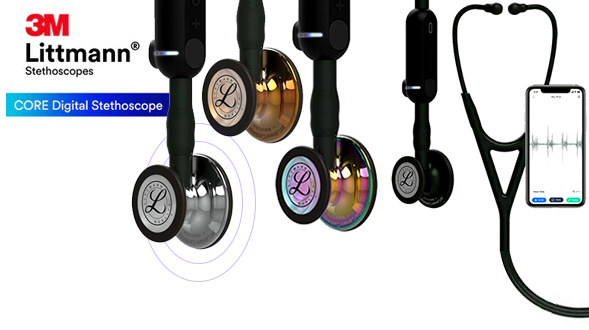
The Littmann CORE Digital is, in my view, the most significant advance in stethoscope technology for pre-hospital clinicians in decades. In addition, its 40× amplification at peak frequency means sounds completely inaudible on a mechanical stethoscope in a noisy environment become clearly discernible. Because its active noise cancellation electronically filters out background ambient noise, it selectively enhances clinical sounds rather than simply amplifying everything. Furthermore, the ability to toggle between analogue and amplified mode means you can use it as a standard instrument in quieter environments and switch when conditions demand it. Therefore, for any paramedic, HEMS clinician or pre-hospital practitioner, the CORE Digital is not a luxury — it is a tool that directly improves clinical capability in the environments where you most need it. Moreover, being able to record sounds via the Eko app means cardiac recordings made on scene can be transmitted securely to the receiving ED before your patient arrives.
Available in four models: 8490 Black, 8863 Black Copper and 8869 High Polish Mirror.
Can You Use a Classic III as a Paramedic?

Yes — and many paramedics do. In addition, for a significant proportion of pre-hospital work — patient assessments in quieter environments, home visits, lower-acuity calls — the Littmann Classic III performs perfectly well. Because the Classic III is the most widely used stethoscope in the world, you are unlikely to go wrong with it as your primary instrument for routine paramedic work. Furthermore, it is considerably more affordable than the CORE Digital. Therefore, if you are a newly qualified paramedic working primarily in ground ambulance environments and budget is a consideration, the Classic III is a sensible starting point. However, if you work in HEMS or regularly face high-noise environments, the CORE Digital’s capabilities will make a meaningful difference.
What I Carry and Why
After 14 years in pre-hospital medicine, I carry a CORE Digital 8490 as my primary instrument. In addition, I keep a Classic III as a backup. Because the CORE Digital runs on battery power and digital electronics, having a mechanical backup for situations where it needs charging is simply good practice. Furthermore, the Classic III backup costs relatively little given the added security it provides. Therefore, my recommendation to any serious pre-hospital clinician is to consider the CORE Digital as your primary and the Classic III as your backup — the combination gives you the best possible acoustic capability across all the environments you encounter.
Frequently Asked Questions
What is the best stethoscope for paramedics?
For ground ambulance paramedics, the Littmann Classic III offers excellent performance at a practical price. For HEMS paramedics and critical care clinicians in high-noise environments, the CORE Digital genuinely changes what is clinically possible in the field.
Can you hear anything with a stethoscope in a helicopter?
With a conventional mechanical stethoscope — barely, or not at all. Because helicopter cabin noise typically exceeds 85–95 dB in flight, the acoustic signal from a patient’s heart or lungs is drowned out entirely. The CORE Digital’s active noise cancellation and 40× amplification is the only stethoscope solution I have found that remains clinically useful in a helicopter cabin.
Is the CORE Digital worth the price for paramedics?
If you work in HEMS or other high-noise pre-hospital environments, yes — without reservation. Because it directly expands what you can assess on scene, it is a clinical tool rather than a luxury. For ground paramedics in lower-noise environments, the Classic III may be the more cost-effective choice.
Browse CORE Digital models at Stethoscope24 | Learn more at Littmann.com
About the author: James Bourke is a HEMS paramedic with 14 years of pre-hospital experience across Dublin and London. He publishes every Friday at 8:00 AM CET.